The aerodynamics of Lilienthal
Bernd Lukasch
Lilienthal's worldwide fame is mainly based on his successful gliding flights. Today we look at his first controlled and so reproducible gliding flights in the year 1891, covering a distance of 80 feet as the beginning of the era of successful human flight. In 1893 Lilienthal covered a distance of 800 feet. Until his death in 1896 this was unsurpassable for him.
These first practical successes were the outcome of a research program on which he worked with great determination and creativity for more than 20 years. Today we can call his research "the beginning of wing-aerodynamics".
It was only after he had presented his full experimental facts and interpretations in his book "Der Vogelflug als Grundlage der Fliegekunst" (Bird Flight as a Basis of Aviation) that he started to construct man-carrying flying machines. Some of his works and discoveries in physics of flight that should be emphasised:
- The conclusive account of the fact, that the mechanic work in order to lift a body (e. g. the body of a bird) in still air is fundamentally different to the flight work of birds.
- The experimental account of the advantages of the curved wing and the attempt to interpret the results through streamlines.
- The disassemble of the resultant air force in its lift and drag components.
- The analysis of the results
in a way that is still used in the same
way today: the so called "polar diagram"
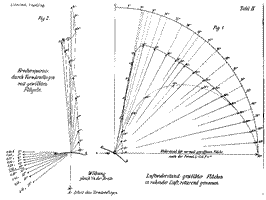
- The analysis of different wing constructions and first statements about aspect ratio, wing shape and profile, which were partly experimentally secured and partly made by intuition
- The development and use of very simple measuring instruments, which supplied among other things the first actual available measurements of ratio and direction of the resultant air force. This was successful because of the largeness of the apparatuses through which some measuring mistakes became irrelevant. Most important measuring instruments were different whirling arm apparatuses and air force measuring instruments for natural wind.
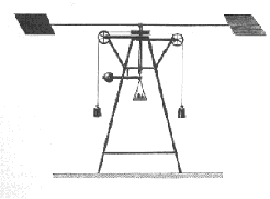
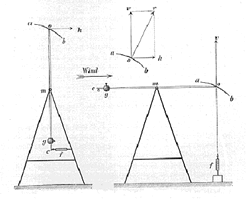
Reconstructions are in the museum.
Lilienthal defined the assignment of his inquiries in an impressive formula:
"All flight is based upon producing air pressure,
all flight energy consists in overcoming air pressure. "