The aeroplane models of Lilienthal
- Earlier glider models
- Derwitzer Glider, 1891
- Südende Glider, 1892
- Maihöhe Rhinow Glider, 1893
- Small Wing-flapping Machine, 1893-96
- Normal Gliders, ab 1894
- Sturmflügelmodell (storm wing model), 1894
- Vorflügelapparat, 1895
- Small Biplane, 1895
- Large Biplane, 1895
- Large Wing-flapping Machine, 1896
- Other designs and models
For Lilienthal, his manned aircraft were objects of experiment. They were frequently altered and adapted during the course of his research and testing. Based on photos, nine different models of his gliders are known, while ideas and plans for many other designs exist. Only the Sturmflügelapparat along with four restored versions or fragments of the Normalsegelapparat are known to have been preserved to this day.
A comprehensive description of Lilienthal's aircraft development is contained in the title Raffel/Lukasch: "The flying man".
Stephan Nitsch carried out the reconstructions for the museum. He is the author of the (German-language) title "Die Flugzeuge von Otto Lilienthal. Technik - Dokumentation - Rekonstruktion" (The Aircraft of Otto Lilienthal. Technology - Documentation - Reconstruction).
Earlier glider models
There are no known photographs documenting Lilienthal’s earliest aircraft. However, several conceptual drafts and various drawings do exist. Based on Lilienthal's statements, it can be assumed that an indefinite number of gliders of different sizes were built. These were the subject of experiments in ambient wind conditions and were used to perform jumps from a purpose built platform.
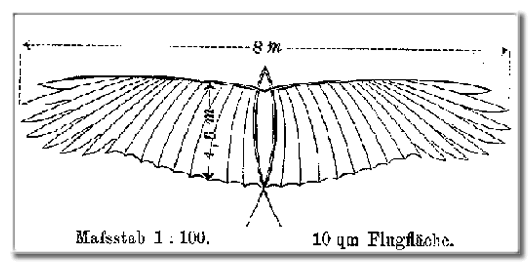
wing span: 14 to 36 ft.
wing area: 28 to 107 sq.ft.
The attempt at a 1/5 scale replica of the glider "Seagull" from 1889 is on display in the museum.

Derwitzer Glider 1891
This was the world's first successful manned glider, flying distances of up to about 80 feet near Derwitz/Krielow in Brandenburg. During this series of experiments, Lilienthal successively reduced the glider’s wingspan. .
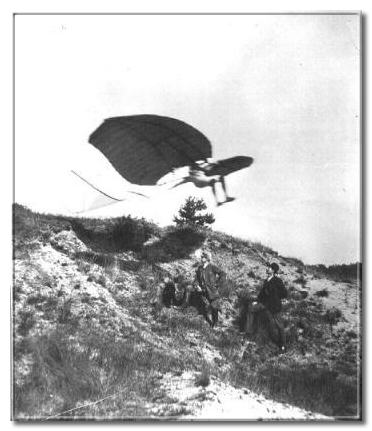
wing span:
about 23 ft.
area:
about 86 sq.ft.
wing curvature:
1/10 of chord
max. chord: 5.6 ft.
length of glider: 12.8 ft.
weight: 18 kg
Original replica according to descriptions and photographs (S.Nitsch) is on display in the museum..

Südende-Glider 1892
Lilienthal described the Südende Glider as “über Lehrgerüst gebauter Segelapparat" (glider built over a jig). It is an aerodynamically sophisticated design with fabric covering both sides of the wings. It flew up to a distance of about 90 ft. (from a launch height of about 30 ft). From Lilienthal’s papers we know of the probable existence of another model of glider which employed a similar design but had different dimensions.
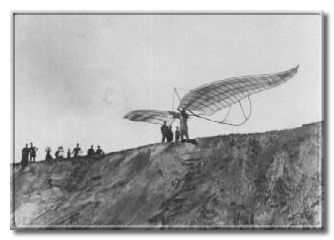
wing span: 31 ft.
wing area: 158 sq.ft.
wing curvature 1/20 of length
max. wing length: 8.2 ft.
length of glider: 18,4 ft.
weight: 24 kg
Replica of the Südende-Glider on display in the museum (S.Nitsch)
Maihöhe-Rhinow-Glider 1893
This glider was referred to by Lilienthal as the “convertible flight apparatus with 14 sqm [150 sq. ft.] wing surface” and “Model 93”. This is the first glider of the new, convertible bat-like design. Folded up the glider measures 6.6 by 10.5 by 1.6 feet. The airfoil shape could be altered by inserting different ribs or Profile Brace-Rails. This design and method of construction is legally protected by a patent. It is the origin of the later Normalsegelapparat. Near Stölln/Rhinow (Brandenburg), Lilienthal made flights from a 200-foot-high hill covering 800 ft.
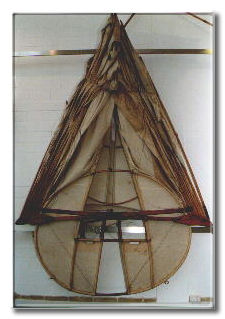
wing span: 22 or 23 ft.
wing area: 150 sq.ft.
max. chord: 8.2 ft.
length of glider: 14.3 ft.
wight: 20 kg
Replica by S. Nitsch
Small Wing-flapping Machine 1893-96
Building upon his reliable existing glider design, Lilienthal attempted to add wing-flapping for motive propulsion. Both muscle-power and motor-power propulsion were planned. In 1894 the first carbonic acid engine was ready for use. Initially, results from tests of the wing-flapping machine were not encouraging. Nevertheless, Lilienthal continued with his attempts to imitate wing flapping of birds.
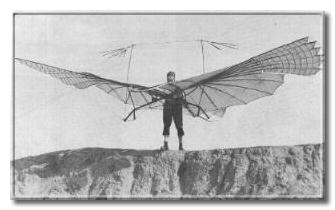
wing span: 22 ft.
wing area: 129 sq.ft.
max. chord: 8.2 ft.
weight of engine: 5.5 kg
(approximately 10 kg including CO2-cylinder)
"Normal Gliders" from 1894 onwards
The design of the Normalsegelapparat (Normal Glider) evolved
from the Model Stölln (used near the village of Stölln). Drawings still exist for two of the first gliders sold: the drafts for Seiler’s and Lambert’s gliders. Later, the Normalsegelapparat was integrated into the Large Biplane.
We know at least nine people bought one of these machines. Four original copies are kept in museums (London, Moscow, Munich and Washington). A Prellbügel (bumper bar) was used to reduce impact in the event of an impact.
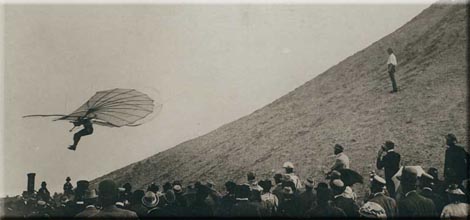
wing span: 22 to 23 ft. wing
area: 140 to 146 sq.ft. max chord: 7.9/8.2 ft.
length of glider: 16.1 to 17.4 ft. weight: about 20
kg
The museum has reproductions of the "Normal Glider" (one by Richter in 1925), and several by Nitsch, who also built the accurate 1/5-scale replica of the "Model Stölln".
Sturmflügel-Modell (Storm Wing Model) 1894
This glider was built according to the same principles of construction as the Normalsegelapparat. The wings were reduced in size to enable withstanding stronger winds. It was later integrated into the small biplane. The original can be seen at Technical Museum in Vienna.
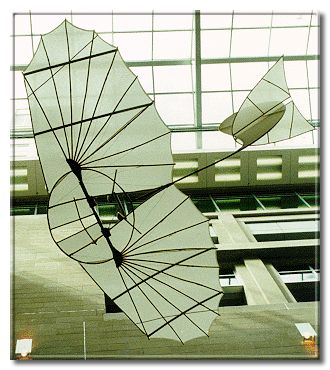
wing span: 20 ft.
wing area: 104 sq.ft.
chord: 6.6 ft.
length of glider: 14.8 ft.
replica (J. Jung)
on loan to ICAO, Montreal
(Int. Civ. Aviation Org.)
another replica: I. Legat
"Vorflügelapparat" 1895
Lilienthal called this large monoplane an Experimental Apparatus. Various control mechanisms were tested on this monoplane glider. The conspicuous Vorflügel (leading edge control surface) was intended to prevent rapid dives in the case of a negative angle of attack. A wing warping control and steerable rear rudder and wingtip rudders (spoilerons) were also tested.
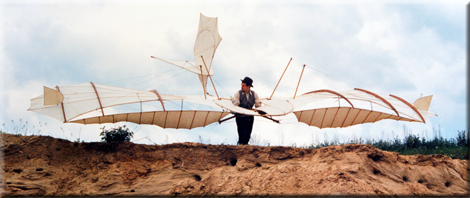
wing span: 29 ft. wing area: 204 sq.ft. max. chord: 9.8 ft. length of glider: 18.4 ft.
Replica with all known control mechanisms: S. Nitsch
Small biplane 1895
The Small Biplane was based on the Sturmflügel-Modell. Lilienthal described his intension by stating: "The biplane design has the same lifting capacity of a single wing with twice the span, but the shorter span is more responsive to changes in the center of gravity." The results were convincing. The original lower wing is preserved in Vienna. The upper wing was preserved in Munich until 1945.
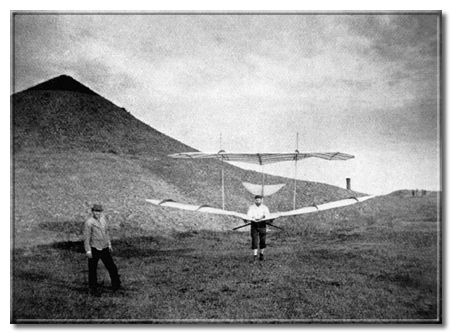
wing span: 19.7 / 17.1 ft.
wing area: 104 / 105 sq.ft.
max. chord: 7.2 / 6.9 ft. length of glider: 15.7
ft.
Replicas: (full scale, 1/5 scale) J. Jung, S. Nitsch
large biplane 1895
The Large Biplane followed on as a result of the outstanding flight performance of the Small Biplane. It consisted of an upper wing being superimposed on a Normalsegelapparat.
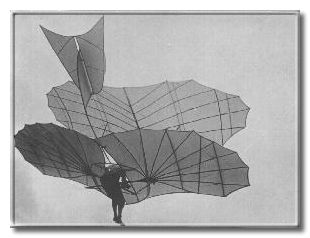
wing span: 21.6 / 20.7 ft.
wing area: 146 / 112 sq.ft.
max. chord: 7.5 / 7.5 ft.
length of glider: 16.1 ft.
Replica (S. Nitsch)
large Wing-flapping machine 1896
The big wing flapping machine was based on the wing-flapping machine of 1893. It is assumed that the glider was completed but not tested. It had been later sold to Etrich, but it is not preserved today.

wingspan: 27.9 ft. wing area: 188 sq.ft. max. chord: 8.2 ft. length of glider: 17.4 ft.
1/5, 1:3 scale replica in the museum
Other designs and layouts
In addition to the detailed replicas, there are sketches, drafts and other primary source materials which cannot be linked to known gliders. A design for a large monoplane which survives today only as a drawing was probably never built. There are sketches of the muscle-powered mechanisms of wing flapping and a helicopter. Designs for a collapsible wing (bat-principle) and a system of two wings placed in tandem, one behind the other were considered and later used by several other aviators.
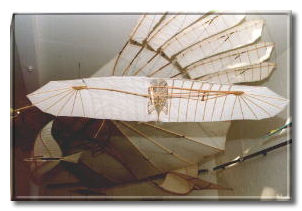 At
the time of Lilienthal's death, the Gelenkflügelapparat (Glider with Jointed Wings), which would allow the pilot to shift
the center of gravity mechanically, was almost ready for test flights. However, little is known about the details of its design.
The museum has a 1/5 scale model of Lilienthal's last design, which
has completely different construction from earlier designs.
At
the time of Lilienthal's death, the Gelenkflügelapparat (Glider with Jointed Wings), which would allow the pilot to shift
the center of gravity mechanically, was almost ready for test flights. However, little is known about the details of its design.
The museum has a 1/5 scale model of Lilienthal's last design, which
has completely different construction from earlier designs.
wing span: 30 ft. area: 215 sq.ft. length of wing : 9.2 ft.
Due to distinct differences in its shape, the Kippflügel-Schlagapparat (Tilt Stroke Wing Glider) thought to derive from the period prior to 1893. It is now thought to date from 1896. Today, it is assumed that this third ornithopter was never built.