
Otto Lilienthal: bird flight as a basis of aviation, New York 1911
XLI
The Construction of Flying Apparatus.
The last section gave us the calculations for the relation between the work necessary for flight and the resulting effect. Extending the conditions on a suitable scale, we must obtain the shapes and dimensions of such apparatus which would serve for human flight.
It is not our object to create sensational impressions, and we leave it to the imagination of our readers to form their opinions as to what man would look like during flight under the above developed considerations. We will, however, shortly recapitulate the fundamental points from which the construction of flying apparatus would have to be evolved, when the experimental results set down in this volume are accepted as a basis for the design.
- The design of practical flying machines is not absolutely dependent upon the provision of powerful and light motors.
- Hovering flight in calm air does not come within the scope of human flight by muscular exertion, this kind of flight requires under the most favourable conditions at least 1.5 h.p. Forward flight, in calm air, with a minimum velocity of 10 m., may be possible to man, but for a short time only, as it requires 0.27 h .p .
- With a wind of mean velocity, the muscular power of man is sufficient to move a suitable flying apparatus, provided a sufficient speed of flight is maintained.
- When the velocity of the wind is above 10 m., sailing flight without muscular effort will be possible for man, provided he uses suitable supporting surfaces.
- Any flying apparatus which will be effective and requiring only a minimum of work must conform in shape and properties with the wings of large and good flying birds.
- For every kilogram of total weight, the supporting area must measure from 1/10 to 1/8 sq. m.
- It is possible to construct a practical apparatus with an area of 10 sq. m. and a weight of about 15 kg., employing willow canes and some textile covering.
- The flight area per kilogram of a human being mounted on such an apparatus, and weighing altogether 90 kg., would be 1/9 sq. m., a figure which corresponds approximately to that applying to the larger birds.
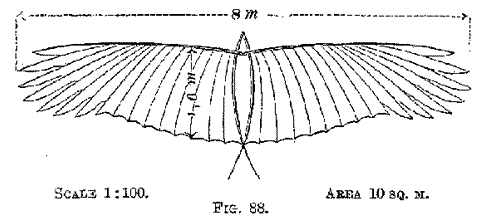
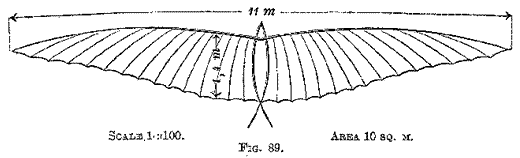
- It will be a matter of experiment to determine whether the broad shape of wing with resolved pinions, such as we birds of prey, or the long pointed shape of wing of the sea are preferable.
- In the former case the dimensions of the wing be 8 m. span, and 1.6 m. greatest width. (See Fig. 88.)
- When employing the slender wing shape, the in birds, would corresponding dimensions would be 11 m. span, and 1.4 m. greatest width. (See Fig. 89.)
- It t is of secondary importance e for the support afforded, whether a tail is fitted or not.
- The wing must show a curvature on the underside.
- The camber of the curvature should be about 1/12 of the width of the wing, in accordance with the construction of a bird's wing.
- Experiments will show whether in the case of larger areas weaker or stronger curvatures offer greater advantage.
- The ribs and stiffenings of the wings should be fitted near the leading edge.
- Whenever possible, this thickened edge should be provided with a tapering edge in front.
- The geometrical shape of the curvature shpuld be a parabola, more curved towards the leading edge and getting straighter towards the back.
- For larger areas the best shape of the curve would have to be established by experiment, and that shape, the pressures upon which for small angles of inclination are most nearly in the direction of movement, should be preferred.
- The design must be such that the wing may rotate around its longitudinal axis, a rotation which is effected wholly or partly by the air pressure itself; this rotation should be strongest towards the wing-tips.
- In ordinary forward flight the broader wing portions near the body are moved as little as possible and act chiefly as supporting surfaces.
- The forward traction which is to maintain the flight velocity is produced by the wing-tips or pinions, which are beaten down with the leading edge inclined downwards.
- The broader wing parts should act as supporting surfaces also during the upstroke.
- The wing-tips should experience a minimum of resistante during the upstroke.
- The downstroke should occupy at least 6/10 of the time necessary for a complete double beat.
- Only the end portion of the wings should take part in the up and down stroke, the supporting wing portions remaining immovable as in sailing,flight.
- The up and down movements of the wing-tips must not take place by means of a joint, or the wing shape will be deformed; the excursion of the tips must, on the contrary, merge gradually into the comparative immovability of the other wing portions.
- Wing-beats which are executed by human muscular power should be effected by means of the legs, not simultaneously but alternately, so that every down-push of the legs produces a double beat.
- The upstroke might be effected by the air pressure itself.
- It would be of advantage to store the effect of air pressure during the upstroke (by means of springs or otherwise) so that it may be utilized again during the down-beat, and thus save work.
These would be some of the chief considerations. But from our own experience we are sure that no one would imagine the lifting effect of the wind to be of such magnitude, as he will actually experience when placed in the wind with such wings.
Human muscular effort is insufficient to operate such wings in a wind without previous training, and in all probability the first result with such an apparatus, although it may be well calculated but lightly built, would be its total wreckage after the very first strong gust of wind.
For this reason we think it necessary to develop a special sense for such wind effects, and at first to practice the safe manipulation of such wings on a smaller scale. Only when we have learned how to act on air and ,wind by means of suitable surfaces - that is, after this has become almost intuitive - may we venture upon a real flight. With this warning we will conclude this section.
It will be left to the skill of the designer to give practical value to the above developed principles of flight by constructing and developing practical wings and supporting surfaces. If at any future time we should have collected sufficient new material relating to such improvements, we may perhaps again publish our results.