Otto Lilienthal: bird flight as a basis of aviation, New York 1911
XXIV
The Advaqtages of Curved Wings
over Plane Surfaces.
In Order to arrive at a comparison between the air pressure on plane and that on curved surfaces, we represent in Figs. 35 and 36 two surfaces, ab and cd, in section, of equal area, making the same angle of about 15° with the horizon, provided we consider the chord cd for the curved surface as its direction.
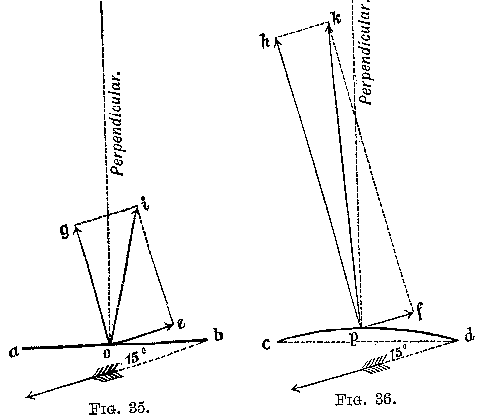
On moving these surfaces horizontally with equal velocity through still air by means of the whirling arrangement shown in Fig. 23, and investigating the resulting air pressure, we obtain the horizontal components oe and pf, and the vertical components og and ph, which have been drawn to scale in the figures from the experiments.
Constructing from these components the resultants oi and plc gives us the absolute magnitude and direction of the air pressure for both surfaces.
To fully grasp the importante of this differente for the requisite flight energy, let us assume the two surfaces to be placed horizontally, and their velocity directed downwards at an angle of 15°; the parallelograms of forces are then shown in Figs. 37 and 38.
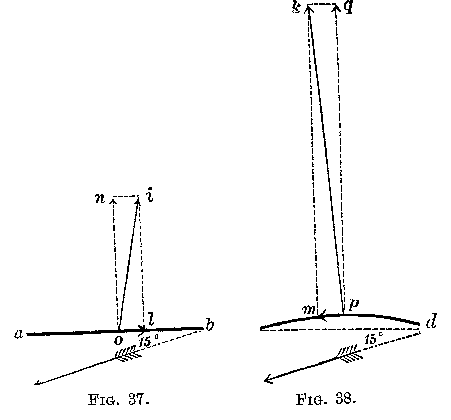
Employing the surfaces ab and cd as wings in this position, with the velocity v, we are at once struck by the fact that the curved surface exerts a greater lifting power for a given Speed, so that it may be possible to move such a surface more slowly than a plane surface whilst yet attaining the Same lifting effect, and thereby economizing "work."
Of still greater importarme, however, is the more favourable direction of the resulting air pressure in the case of a curved surface. The retarding component, ol, of the plane surface is replaced by a pv,shing component, pin, so that the real obstacle to the attainment of power economy in forward flight is removed when using a curved surface, which possesses all those advantages so lang and unsuccessfully searched for in the case of plane wings.
Before we occupy ourselves more closely with the resulting power economy, we propose considering theoretically the Causes of these phenomena, which are of equal importante for the bird-world and for aviation.